In the high-stakes environment of US higher education in 2026, the “first impression” has moved beyond simple grammar. With the recent return to mandatory SAT/ACT submissions at several Ivy League institutions and a renewed focus on “human-centric” storytelling in admissions, the pressure to stand out begins with the very first sentence. American professors and admissions officers now review work through a lens that prioritizes unique voice and critical thought.
If you don’t capture interest within the first 15 seconds, you are essentially fighting an uphill battle for the rest of the 2,000 words. Mastering the “Hook” isn’t just a creative flourish; it is a strategic necessity for academic survival in the USA.
Why the First Paragraph is Your Academic “Elevator Pitch”
The introduction serves as the roadmap for your entire argument. In the US academic tradition, we follow a “Claim-First” model. This means your reader expects to be oriented immediately. A weak start suggests a weak argument. Conversely, a compelling hook signals to your professor that you have not only mastered the material but also possess the ability to synthesize complex ideas into an engaging narrative.
It is strategically smart to do my assignment for me so that the intricate structural requirements managed by the professionals at MyAssignmentHelp can meet the demanding standards of the modern American academic grading system.
The Anatomy of a High-Impact Hook
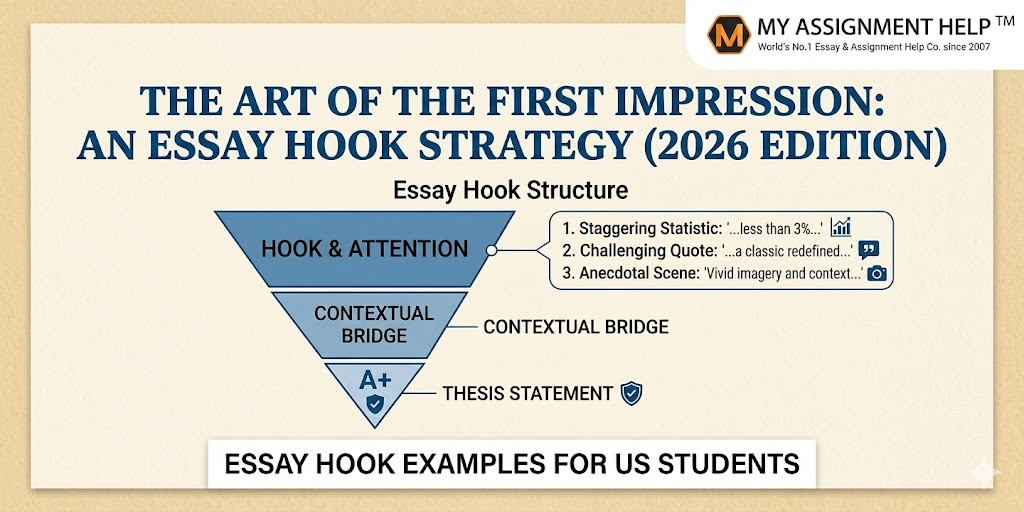
A “hook” is typically the first one to three sentences of your essay. Its primary job is to create a “curiosity gap”—a mental itch that the reader can only scratch by reading the rest of your work. According to recent writing center standards at top-tier US colleges, hooks generally fall into four data-backed categories:
- The Provocative Statistic: “While 70% of Americans support climate action, less than 3% can identify the primary source of their local power grid.”
- The Anecdotal Narrative: Starting with a specific, vivid scene that embodies your thesis.
- The “Inverted” Quote: Using a famous quote but immediately challenging its validity in a modern context.
- The Misconception Buster: Starting with a common “truth” and immediately debunking it with your research.
If you are struggling to categorize your specific topic, reviewing a curated list of essay hook examples can provide the specific template you need to match the tone of your assignment, whether it’s a narrative, argumentative, or analytical paper.
Key Takeaways for Students
- The 15-Second Rule: You have roughly one paragraph to convince a professor your paper is worth an ‘A’.
- Context over Definition: Never start with a dictionary; start with a problem or a paradox.
- The Bridge is Key: A hook is useless if it doesn’t lead directly to your thesis statement.
- Professional Leverage: Services like MyAssignmentHelp help students balance complex 2026 curricula with high-quality output.
FAQ Section
Q: How long should an essay hook be?
Ideally, keep it between 1 to 3 sentences. It should be punchy and direct, occupying no more than 10% of your total introduction.
Q: Can I use a question as a hook?
Yes, but avoid “Yes/No” questions. Use “To what extent” questions that require the reader to think deeply about the answer you are about to provide.
About the Author
Dr. Sarah Jenkins is a Senior Academic Strategist at MyAssignmentHelp. With a PhD from a leading US research university, Dr. Jenkins has spent over a decade navigating the evolution of American pedagogy. In 2026, her work focuses on helping students navigate the “Post-AI” academic world, specializing in developing human-led content that meets the strict E-E-A-T requirements of modern US universities and the revised 2026 standardized testing formats. She has successfully overseen the delivery of over 5,000 custom assignments tailored to US institutional standards.